http://www.bbc.co.uk/news/world-middle-east-17962542
Syrian curator and
calligrapher Khaled al-Saai looks intently at the stark painting of a
man holding a horizontal scimitar - a sabre with a curved blade -
fashioned out of carefully crafted Arabic letters.
It spells out the phrase "If Words Could Kill" and, for Saai,
this graphic, modern work by Iraqi artist Ayad al-Kadhi, dovetails
neatly with the theme of Sharjah's Calligraphy Biennial."The theme is Universe and that refers to the global reach of calligraphy," he explains.
"But it also suggests that elaborately ornamented writing has dimensions that ordinary painting often can't achieve."
As well as the demanding discipline of Arabic calligraphy to illustrate verses from the Koran, the fifth edition of the Gulf emirate's large exhibition has plenty of modern and contemporary works from around the globe.
Classical script
As Hisham al-Madhloum, co-ordinator for the biennial explains, the refined script that is used for religious texts is part of the Gulf's Islamic heritage.
 For Khaled al-Saai, Ayad al-Kadhi's work dovetails neatly with the theme of the biennial event
With two months of workshops, conferences, lectures and visits to local art institutions, Sharjah's broad-minded approach brings together calligraphers from Japan, the US, Europe and China who learn techniques from their Arabic counterparts.
This artistic exchange is appreciated by both artists and audience.
Beyond language
Chinese calligrapher Tai Xiangzhou whose innovative digital work, Observing the Heaven, Knowing the Earth, is based on the patterns of constellations that were used as the basis for Chinese script, is keen that his work be understood in the Gulf.
"This is an interactive, multi-media piece that doesn't require the onlooker to understand Chinese," Tai points out.
 Chinese calligrapher Tai Xiangzhou is convinced that art transcends language
Alternating with Sharjah's renown, cutting-edge, contemporary art biennial, the calligraphy event is reflecting a more innovative approach than many other Arab calligraphic events in the region.
Along with British Bhuddist Tashimannox's precisely executed brush-strokes, large-scale Japanese wall hangings and controversial calligraphy-inspired images of women by the Moroccan artist Lalla Essaydi, Sudanese calligrapher Hassan Musa has a series of animals painted on cloth and accompanied by cryptic messages in Arabic.
"These images were first seen in children's publications," says the book illustrator who works in France.
"In all cultures, animals are used to suggest human strengths and foibles. The winged horse, tiger, ostrich and crocodile suggest characteristics that cross boundaries. Arabic calligraphy adds to this, but you can grasp the meaning even if you don't know Arabic."
Earnest conversations
Although Turkey and Iraq have the longest and most illustrious links to classical Arabic calligraphy, participants have come from all over the Islamic world. They can be found in earnest conversation discussing tiny details of the placement, size and angle of single letters.
Mastering the intricacies of the script, shaping passages in an original pattern that conforms to the language's structural requirements takes many years of practice.
 Modern calligraphy combines an ancient art with new themes
"I am somewhere in the middle between traditional and contemporary," he explains. "Using classical script but laid out so as to attract an audience that might not otherwise pay attention to calligraphy."
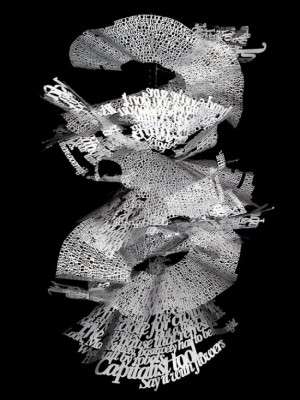
One of the more engrossing workshops open to amateurs and professionals is held in the main art museum. It entails cutting stiff paper into the shapes of letters from a variety of alphabets.
The American leading the workshop, Ebon Heath, invites participants to string the letters together to create sentences and then twist them into mobiles that are art in their own right.
Mohammed, an Egyptian calligrapher busy with scissors, is fascinated to discover that connecting letters from different alphabets creates an extraordinarily beautiful outline that he is able to hang from the ceiling.
"I don't speak English well, but I can see a harmony that comes from bringing all these letters together," he says. "I never thought they could mix so well."


 nh
nh